
Getting a customer to start a WooCommerce subscription is only the first step. The real challenge is keeping that subscription active month after month.
Customers churn for very different reasons. Some actively cancel because they no longer see enough value. Others leave because a renewal payment fails, their needs change, or the subscription becomes inconvenient to manage.
That means reducing churn isn’t about sending more promotional emails or offering discounts to everyone who cancels. You first need to identify why subscribers are leaving, then fix the specific point of friction.
In this guide, you’ll learn how to calculate WooCommerce subscription churn, distinguish voluntary from involuntary churn, identify where customers are dropping off, and use payment recovery, flexible subscription management, customer engagement, and behavioral data to reduce avoidable churn.
What is subscription churn?
Subscription churn is the rate at which active subscribers cancel or stop paying during a specific period.
For example, if you have 500 active subscribers at the beginning of the month and 25 leave during that month, your subscriber churn rate is:
Subscriber churn rate = (Subscribers lost during the period ÷ Subscribers at the start of the period) × 100
In this example:
(25 ÷ 500) × 100 = 5%
But subscriber churn isn’t the only number worth tracking. If customers on expensive plans are leaving faster than customers on cheaper plans, your revenue churn can tell a very different story.
Putler, for example, tracks both user churn and revenue churn as subscription metrics. Revenue churn measures the recurring revenue lost through cancellations and downgrades rather than simply counting customers.
Real impact of churn on your business
Churn doesn’t just reduce your subscriber count. It compounds over time and hinders your growth potential.
Impact #1: Revenue loss is exponential
Losing 5% of subscribers monthly might seem manageable. But compound that over a year.
You’re not losing 60%; you’re losing far more when you factor in the revenue those subscribers would have generated.
A subscriber paying $30/month represents $360/year. Lose 50 subscribers? That’s $18,000 in annual recurring revenue gone from your store.
Impact #2: Customer acquisition costs skyrocket
Every subscriber you lose needs to be replaced just to maintain current revenue.
That means more ads spend, more marketing effort and more resources devoted to acquisition instead of growth.
Impact #3: Lifetime value decreases
Customer Lifetime Value (CLTV) is the total revenue a subscriber generates over their entire relationship with your business.
High churn means shorter customer or subscriber relationships. Shorter relationships mean lower CLV.
Lower CLV means you can afford to spend less on acquisition. It’s a vicious downward spiral.
Impact #4: Affects growth potential
Here’s the math that keeps subscription business owners awake at night. If your churn rate exceeds your growth rate, your business shrinks.
You can acquire 100 new subscribers monthly, but if you’re losing 120, you’re going backwards.
Impact #5: Team morale suffers
Constantly losing customers affects your team. Your support staff hear complaints while the marketing team feels pressure to acquire more.
Everyone in the business feels the impact of a high churn rate in your business.
What causes subscription churn in WooCommerce?
There isn’t one universal reason customers cancel. The useful distinction is between involuntary churn and voluntary churn.
1. Involuntary churn
Involuntary churn happens when a customer doesn’t intentionally decide to leave, but their subscription stops because a payment cannot be collected.
Common examples include:
- expired or replaced cards
- insufficient funds
- temporary bank declines
- payment-method problems
- authentication or gateway issues
This is one of the first areas to investigate because the customer may still want your product.
WooCommerce Subscriptions, for example, provides an automatic retry system for failed recurring payments. When a recurring payment fails, the subscription can be placed on hold while the system attempts recovery according to the configured retry rules.
The important lesson: don’t treat every failed renewal as a customer who decided to churn.
2. Voluntary churn
Voluntary churn happens when the customer actively decides that the subscription is no longer worth continuing.
Common reasons include:
- the product no longer provides enough value
- the customer isn’t using the subscription
- the price feels too high
- the customer found a better alternative
- the customer’s needs changed
- the subscription is inconvenient
These reasons require very different responses.
A customer saying “I don’t use it enough” may benefit from a pause option or better onboarding. A customer saying “It’s too expensive” might be better served by a downgrade. A customer saying “I found a better alternative” points to a product or positioning problem that a coupon won’t necessarily fix.
How to reduce subscription churn in WooCommerce
Once you know why customers are leaving, you can work on the specific points where churn occurs.
1. Recover failed renewal payments automatically
Start with failed payments because they are often the easiest churn to prevent.
Don’t wait for a customer to notice that their subscription stopped working. Configure automatic retries where your subscription system and gateway support them, and send a clear message explaining how the customer can update their payment method.
A useful recovery flow looks like this:
- The renewal fails.
- The subscription remains recoverable rather than being immediately treated as lost.
- The customer receives a payment-failure notification.
- The system retries the payment according to its configured retry schedule.
- The customer can update their payment method and complete the failed payment.
WooCommerce’s subscription system specifically provides automatic retry functionality for failed recurring payments because a temporary decline doesn’t necessarily mean the customer wants to cancel.
If you’re using Smart Subscriptions for WooCommerce, its failed-payment recovery functionality can automatically retry failed payments rather than immediately losing the subscription.
2. Find out why customers are cancelling
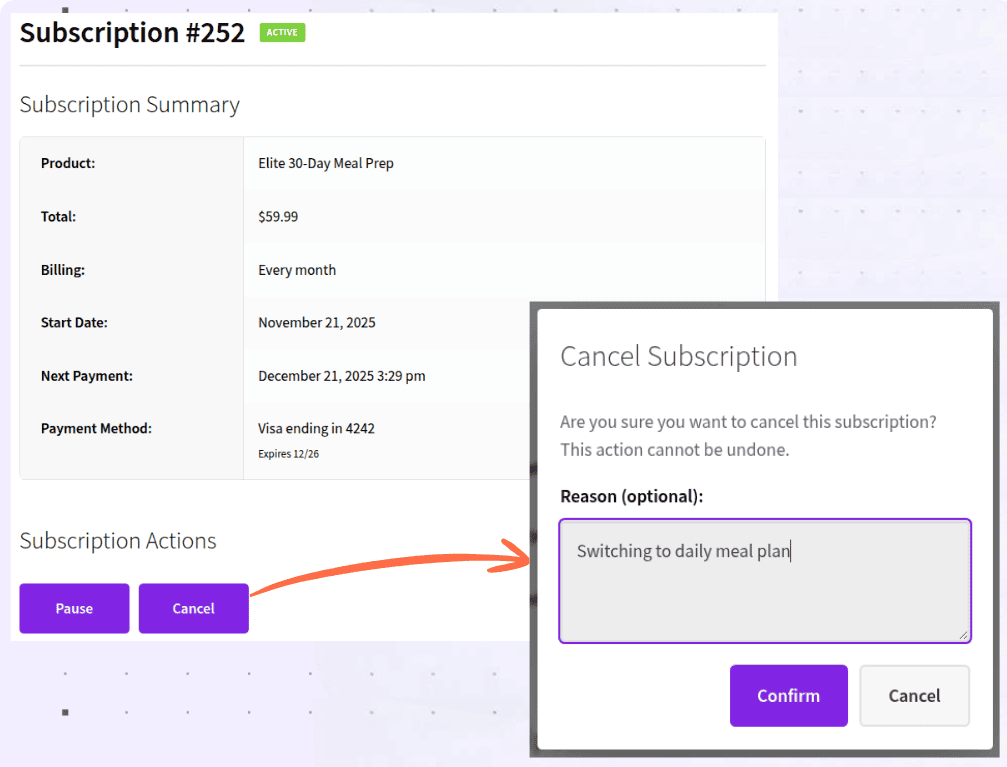
Your cancellation page can become a surprisingly useful source of retention data.
Instead of asking only “Are you sure you want to cancel?”, ask a short, structured question:
- Too expensive
- Not using it enough
- Product didn’t meet expectations
- Need a temporary break
- Found an alternative
- Other
Then connect the answer to an appropriate action.
| Cancellation reason | Possible retention action |
|---|---|
| Too expensive | Offer a lower-priced plan or suitable discount |
| Not using it | Offer a pause or improve onboarding |
| Need a break | Offer a temporary pause instead of cancellation |
| Product didn’t meet expectations | Collect feedback and investigate the product experience |
| Found an alternative | Study the competitor and identify the missing value |
This is much more useful than giving every cancelling customer the same discount.
3. Give customers a pause option
Sometimes cancellation doesn’t mean “I don’t want your product anymore.” It means “I don’t need it right now.”
That distinction matters for seasonal products, memberships, subscription boxes, and services.
For example, a customer receiving a monthly skincare box may have accumulated enough products for the moment. If the only choices are “continue paying” or “cancel,” cancellation is the obvious option.
A pause option changes the decision:
“Pause for two months and come back when you need your next box.”
That preserves the customer relationship without forcing someone to keep paying for something they don’t currently need.
4. Make the first part of the subscription valuable quickly
Early churn deserves special attention.
If customers regularly cancel within the first one or two billing cycles, don’t immediately assume your pricing is the problem. Look at what happens between signup and cancellation.
Ask:
- Did the customer receive what they expected?
- Did they reach the product’s first meaningful outcome?
- Did they understand how to use the subscription?
- Did the first delivery arrive on time?
- Did they use the features they subscribed for?
For a membership, that first value milestone might be completing a course module. For software, it could be creating the first project. For a physical subscription, it could simply be receiving the first order on time and in good condition.
The goal is not to send more onboarding emails. It’s to get customers to the point where the subscription proves its value.
5. Don’t hide the value behind generic engagement emails
“We miss you” isn’t particularly useful if the customer doesn’t know why they should continue paying.
Instead, make the value concrete.
For example, a membership email could show:
- new content added this month
- courses or resources the customer hasn’t used yet
- their progress
- upcoming member benefits
A physical subscription could highlight:
- what is included in the next shipment
- when it will ship
- personalization options
- new products available to subscribers
The principle is simple: remind customers what they are paying for, not merely that they are a subscriber.
6. Give customers flexibility before they reach the cancellation page
Subscription management should account for the reasons customers need to leave.
Depending on your business model, useful options can include:
- pause the subscription
- resume a paused subscription
- change billing frequency
- downgrade to a cheaper plan
- change delivery frequency
- update payment details
Not every store needs all of these. The right options depend on what customers actually ask for.
If support tickets repeatedly say “I don’t need this every month,” adding a quarterly option may solve a real retention problem. If customers say “I can’t afford it this month,” a pause or downgrade may be more appropriate.
7. Watch first-renewal and early post-renewal churn
Your overall churn rate can hide important patterns.
Compare customers who cancel:
- before the first renewal
- after one or two renewals
- after several months
- after a year or more
A spike immediately after the first payment suggests a different problem from customers leaving after 18 months.
Early churn can point to acquisition quality, misleading expectations, poor onboarding, or weak initial value.
Late churn may indicate changing customer needs, product fatigue, pricing pressure, or competitors catching up.
Don’t use one retention tactic for both.
8. Use customer segmentation to identify who is at risk
Churn analysis becomes more useful when you stop treating every subscriber as identical.
RFM analysis, Recency, Frequency, and Monetary value, can help you segment customers according to purchasing behavior and identify groups that need attention.
Putler’s RFM analysis includes segments such as At Risk, Hibernating, Loyal Customers, and Champions. Its subscription reporting also includes metrics such as user churn, revenue churn, upgrades, downgrades, trials-to-paid, and reactivated customers.
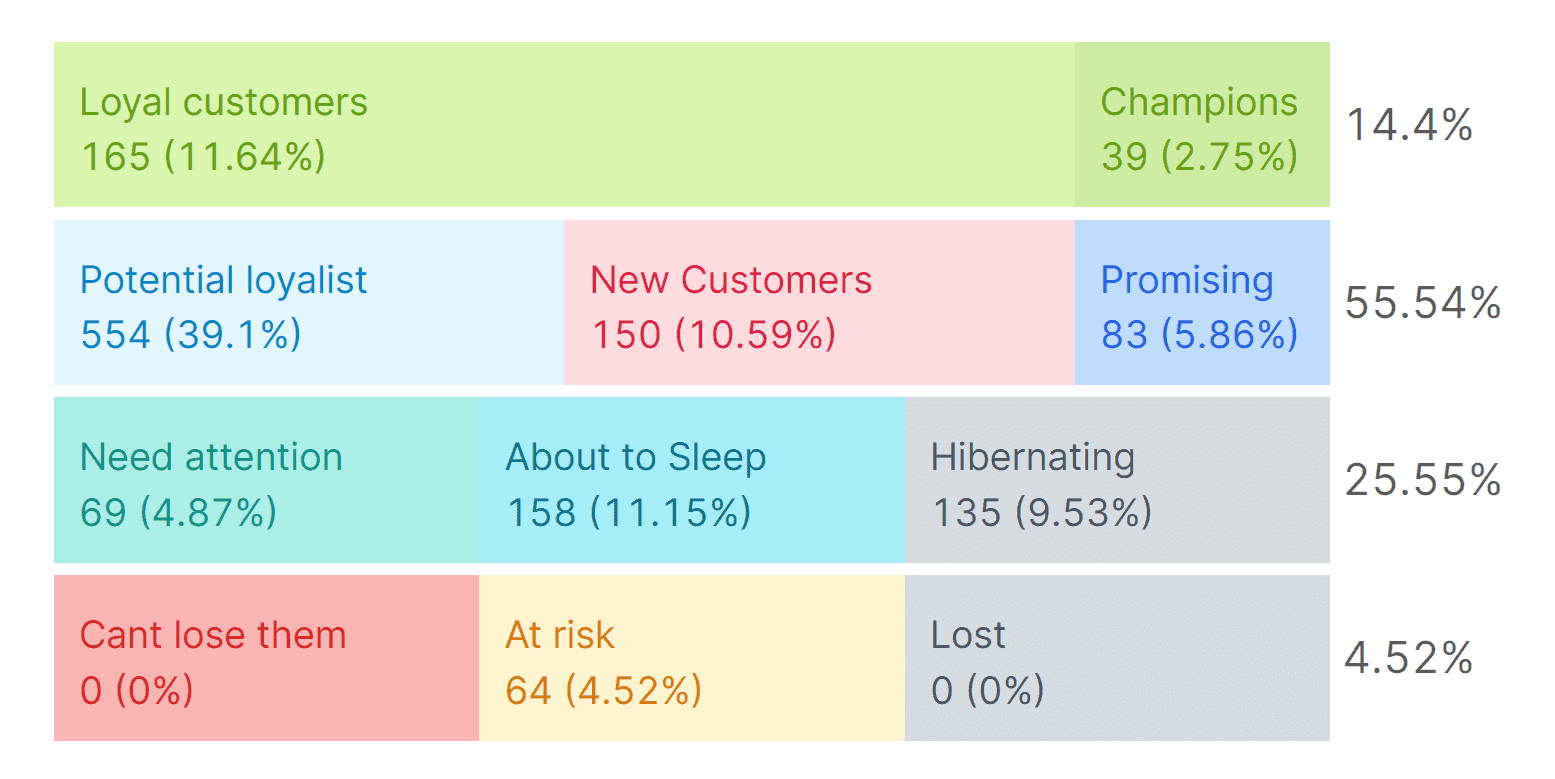
This gives you a more useful question than “What’s our churn rate?”
Which customers are showing behavior that suggests they’re becoming less engaged?
For example, an at-risk customer who used to purchase frequently but hasn’t purchased recently may deserve a different message from a brand-new subscriber who hasn’t completed onboarding.
Putler can help you analyze these customer segments and drill into individual customer behavior so your retention campaigns aren’t based purely on guesswork.
Which WooCommerce subscription metrics should you track?
Churn shouldn’t be the only number on your retention dashboard.
Track these together:
| Metric | What it tells you |
|---|---|
| Subscriber churn | How quickly your subscriber base is shrinking |
| Revenue churn | How much recurring revenue you’re losing |
| Failed renewals | How much churn may be payment-related |
| Trial-to-paid conversion | Whether trials are producing paying customers |
| First-renewal rate | Whether new subscribers make it past the first billing cycle |
| Reactivation rate | How many cancelled customers return |
| Upgrade/downgrade rate | Whether customers are changing plans instead of leaving entirely |
Looking at these together can reveal patterns that a single churn percentage cannot.
How to reduce involuntary churn vs voluntary churn
The distinction is worth making because the solutions are completely different.
| Type | What is happening | What to improve |
|---|---|---|
| Involuntary churn | Payment cannot be collected | Retries, payment-update reminders, recovery workflows |
| Value-related churn | Customer doesn’t see enough benefit | Onboarding, product experience, value communication |
| Price-related churn | Subscription no longer fits the customer’s budget | Downgrades, suitable plans, pricing review |
| Convenience-related churn | Subscription is difficult to manage or doesn’t fit usage | Pause, frequency changes, self-service management |
| Competitive churn | Customer moves to another provider | Product differentiation and customer feedback |
This is why “offer a discount to reduce churn” is weak retention advice. A discount may help one segment while doing nothing for customers who can’t successfully pay or simply don’t use the product.
How Smart Subscriptions for WooCommerce can help reduce churn?
A subscription plugin can’t fix product-market fit or make an unneeded subscription valuable. What it can do is remove operational problems that cause avoidable churn.
Smart Subscriptions for WooCommerce is designed for straightforward WooCommerce subscription businesses that need recurring billing and subscription management without an unnecessarily complex setup.
For retention, the useful capabilities are the ones that address actual subscription friction:
- automatic recurring payments through Stripe
- failed-payment recovery
- customer subscription management
- pause and resume functionality
- clear subscription status and billing management
Use these features to solve a specific retention problem rather than enabling every option simply because it exists.
A practical WooCommerce churn-reduction workflow
If you’re not sure where to start, don’t launch five retention campaigns at once.
Work through the problem in this order:
- Calculate churn: Establish your current subscriber and revenue churn.
- Separate payment failures from active cancellations: They require different solutions.
- Analyze cancellation reasons: Look for repeated patterns rather than individual anecdotes.
- Check early churn: Compare first-renewal customers with long-term subscribers.
- Fix payment recovery: Recover customers who never intended to leave.
- Add flexibility where the data supports it. Pause, downgrade, or billing-frequency changes should solve real customer problems.
- Improve the first-value experience: Help new subscribers understand why staying is worthwhile.
- Segment at-risk customers: Use behavioral data to target retention campaigns instead of messaging everyone.
- Measure the result: Check whether churn, first-renewal rate, and recovered payments actually improve.
Don’t confuse lower churn with forced retention
There is an important difference between reducing avoidable churn and making cancellation difficult.
Hiding cancellation links, adding unnecessary steps, or continuing to charge customers who are trying to leave may reduce your reported cancellations temporarily. It doesn’t create loyal customers.
A healthier retention strategy makes it easy for customers to manage their subscription while giving them good reasons to keep it.
If a customer wants to pause, let them pause. If their card failed, help them recover the payment. If they don’t understand the product’s value, improve onboarding. If they consistently say the price is too high, investigate whether your pricing or plan structure makes sense.
Good retention removes the reasons customers don’t want to stay. It doesn’t remove their ability to leave.
Final thoughts
Subscription churn is not a single WooCommerce problem that can be solved with one plugin or one discount campaign.
Start by finding out why customers are leaving. Then match the solution to the reason.
Recover failed payments. Make the first customer experience useful. Give customers flexibility when their circumstances change. Track cancellation reasons. And use customer behavior data to identify subscribers who need attention before they disappear.
For straightforward WooCommerce subscriptions, Smart Subscriptions for WooCommerce can handle the recurring billing and subscription-management side, while tools such as Putler can help you understand customer and subscription behavior at a broader level.
The objective isn’t to make your churn rate look good on a dashboard. It’s to build a subscription customers have a reason to keep paying for.
FAQs
What is a good churn rate for a WooCommerce subscription business?
There is no single churn rate that works for every subscription business. A useful benchmark depends on your product type, pricing, billing frequency, and customer lifecycle. Track your churn over time and compare it with your own historical performance rather than relying on a generic target.
Should I measure voluntary and involuntary churn separately?
Yes. Separating the two helps you identify the right fix. If involuntary churn is high, focus on payment retries, expired cards, and payment-method updates. If voluntary churn is high, investigate product value, pricing, customer experience, and cancellation reasons.
How often should I review subscription churn?
Review churn at least monthly, but don’t rely on the overall monthly rate alone. Break it down by product, subscription plan, customer tenure, cancellation reason, and payment status. This can reveal whether churn is concentrated among new subscribers, specific plans, or customers experiencing payment problems.
Why is early subscription churn important?
Early churn can indicate that customers aren’t reaching the expected value quickly enough. Look at cancellations during the first few billing cycles separately from long-term churn. If many new subscribers leave quickly, review onboarding, product expectations, first-order experience, and the time it takes customers to experience value.
Can reducing involuntary churn improve customer lifetime value?
Yes. Recovering a failed renewal can extend the customer’s subscription without acquiring another customer. Even small improvements in payment recovery can protect recurring revenue and increase the revenue generated by existing subscribers.