

Running a WooCommerce store, you will eventually need a product that is almost identical to one you already have. Duplication is the shortcut: clone an existing product and adjust the details instead of building from scratch.
At one product, that is trivial. But once you are duplicating dozens of products a month – launching variants, building wholesale versions, or rolling out a new category, it stops being a one-off task and becomes a habit with real failure points.
Skip the review step after cloning, and you risk SKU conflicts in your POS, stock counts that do not reflect reality, or product pages so similar that search engines treat them as duplicate content.
Why duplicate products instead of creating from scratch?
If a new product is similar to one you already sell, you don’t need to build everything again. Duplicate the existing product and change what is different.
For example, if an existing Hoodie has four colors and five sizes, duplicating it gives you the new product with those variations already in place. You can then update the name, images, SKUs, prices, stock, and other details.
This works for both simple and variable products:
- Reuse the existing structure – including variations, attributes, pricing, and other settings.
- Change only what is different – instead of rebuilding the product from scratch.
- Save repetitive work – especially when a product has many variations or you’re creating several similar products.
For an occasional simple product, creating it from scratch may be just as easy. But when you’re building products with a similar structure repeatedly, duplication saves real time.
How to duplicate a product using native WooCommerce?
WooCommerce includes a built-in duplication option, useful for one-off cloning.
- Go to
Productsin your WordPress dashboard. - Hover over the product you want to copy.
- Click
Duplicate.
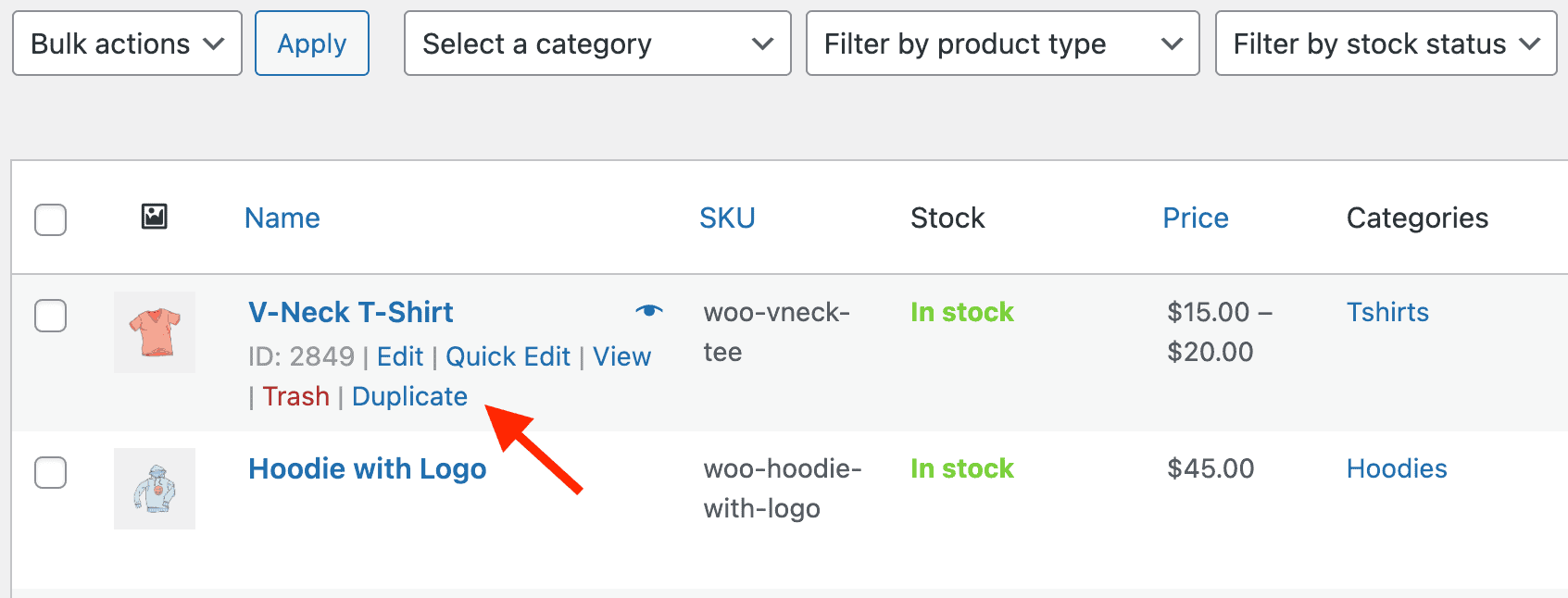
WooCommerce opens the copy directly as a draft, ready for editing before it goes live.
What WooCommerce actually duplicates
- Title: Copied with ” (Copy)” appended to the end.
- Status: Always set to Draft. Nothing gets published automatically.
- Pricing: Regular price, sale price, and tax settings are copied as it is.
- SKU: WooCommerce appends a numeric suffix to keep it unique (e.g.,
BOOTS-01becomesBOOTS-01-1). It still needs a deliberate, meaningful SKU before you publish. - Stock: quantity, stock status, and backorder settings all carry over from the source product.
- Variations: For variable products, each variation is cloned along with the parent, referencing the same existing attribute terms rather than creating new ones.
- Images and descriptions: Featured image, gallery, and both descriptions are copied in full.
- Reviews and ratings: Reset to zero. A duplicated product does not inherit the original’s rating or review count.
Where the native method falls short
- One at a time only: There is no way to duplicate multiple products from the list view in one action.
- No bulk category duplication: Rolling out a new line based on an entire existing category means clicking Duplicate on each product individually.
- Manual review across many tabs: Checking SKUs, prices, and variations across a batch of cloned products means opening and editing each one separately.
- Limited to products: Duplicating orders, coupons, or other post types needs a separate tool.
For the occasional clone, this is all you need. For a growing catalog with frequent duplication, it becomes a bottleneck fast.
What to check after duplicating any WooCommerce product?
Skipping a post-duplication review is how quick shortcuts create messy inventory. Whether using the native Duplicate link or batch cloning using tools, verify these seven core areas before hitting publish:
- Product identity & URL – Update the title, remove the (Copy) suffix, check the permalink slug, and replace the auto-suffixed SKU with a deliberate identifier.
- Product structure – Confirm the product type, categories, tags, attributes, and variations are correct for the new product.
- Price & availability – Review regular and sale prices, stock quantity, stock status, and backorder settings rather than assuming they should match the original.
- Content & images – Update descriptions, featured images, and gallery images wherever the new product differs. Avoid publishing near-identical product pages with little unique value.
- Marketplace identifiers – If you use Google Shopping, Amazon, or another marketplace, check GTIN, EAN, MPN, barcode, and other feed-specific identifiers before the duplicate goes live.
- Third-party plugin data – Check extension-specific settings such as subscriptions, bundles, deposits, bulk pricing, add-ons, or custom product fields to make sure they transferred correctly.
- Final check – Confirm reviews and ratings are correct, preview the product, and test variations, add-to-cart, images, and other key functionality before publishing.
Why Smart Manager is a better option for duplicating products
Native duplication works well for the occasional clone. It gets slow once duplication becomes a recurring part of managing your catalog – launching a full set of variations, cloning an entire category, or duplicating your whole store for a staging test.
Smart Manager gives you a spreadsheet-style screen inside WordPress where you can select multiple products or your entire catalog and duplicate them in one action, then edit the results (names, SKUs, prices, stock) directly in the grid instead of opening each product individually.
How to duplicate products with Smart Manager
- Go to
WordPress admin > Smart Managerand selectProductsfrom the dropdown. - Use search or Advanced Search to narrow down to the products you want, or select them manually.
- Click
Duplicate, then choose Selected Records or Entire Store. - Confirm, and the selected products are duplicated.
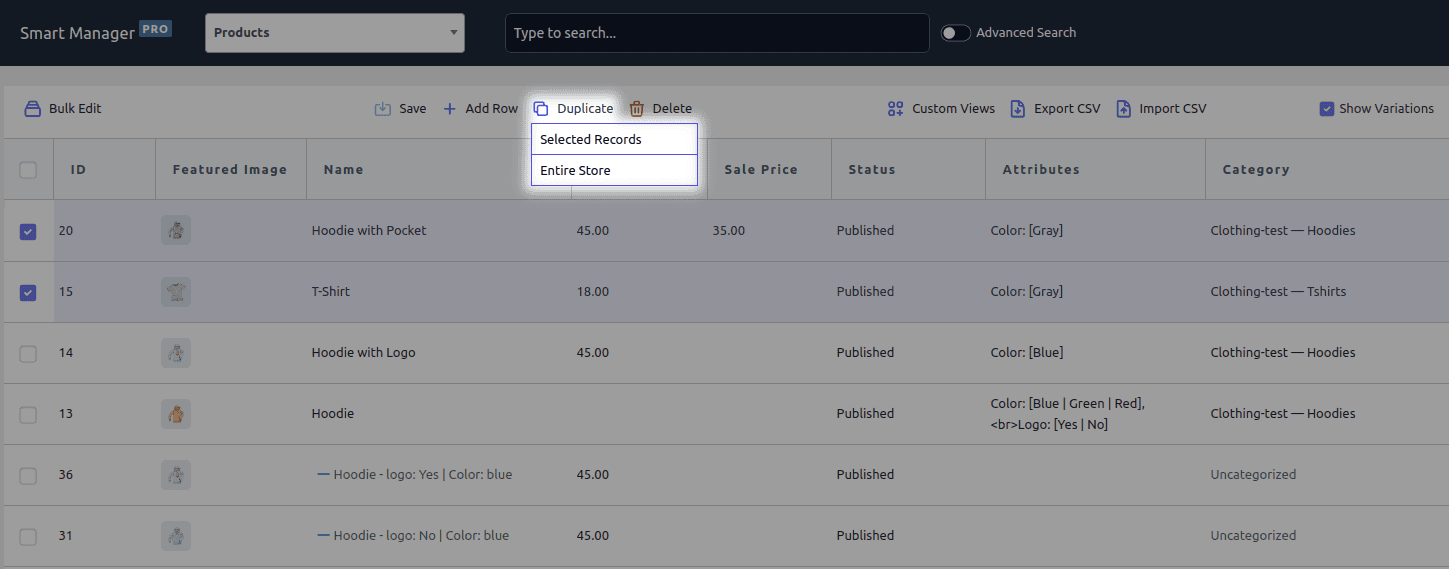
Work through the post-duplication checklist above directly in the spreadsheet view; update names, SKUs, prices, and stock in place.
Try duplicating products using live demo
Practical use cases
If you are cloning one product every couple of months, the native method is already built in and free. But if dealing with hundreds of products, Smart Manager will be a valuable arsenal for your store.
Launching a product with multiple variations
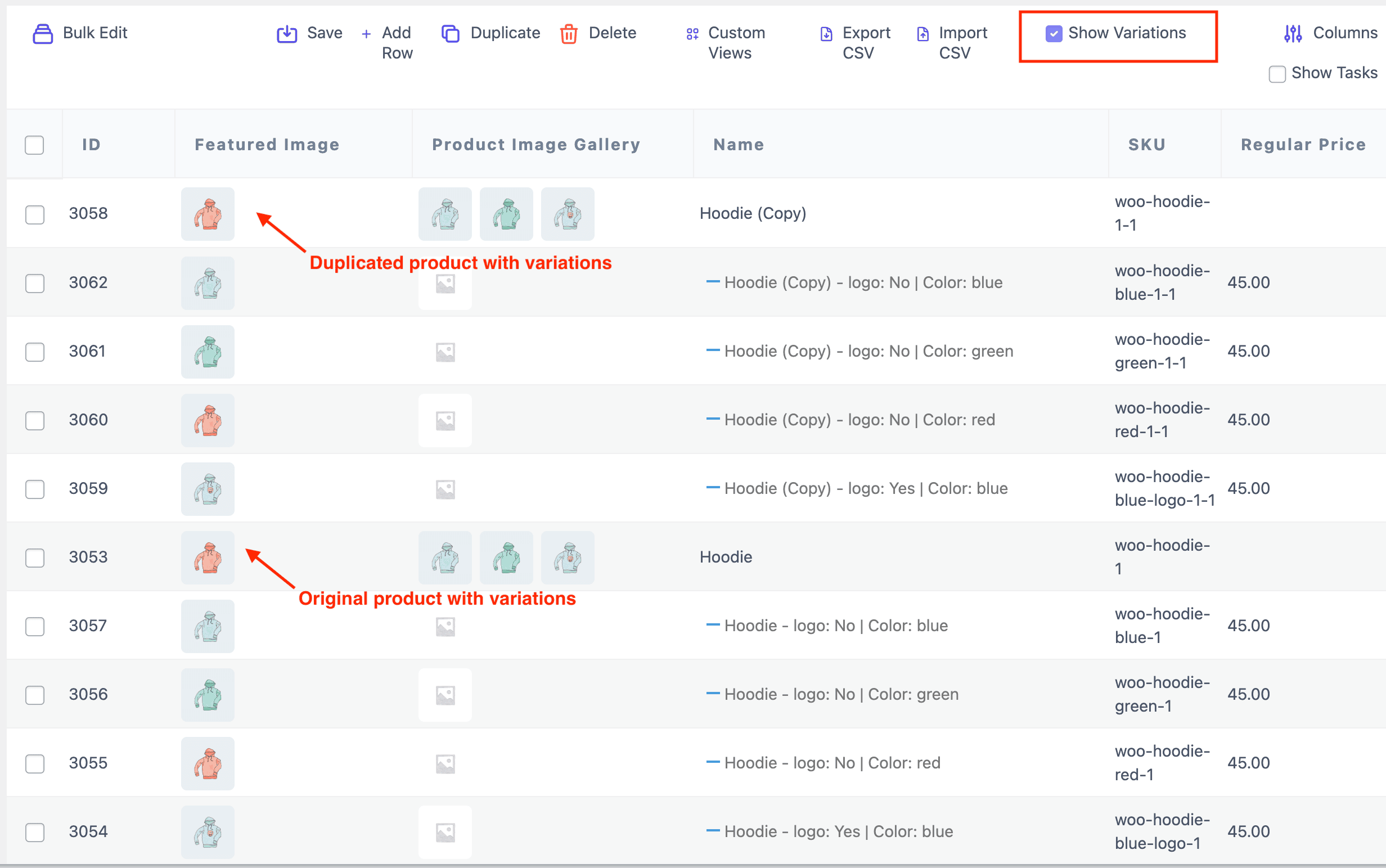
You are launching a hoodie in four color options.
- Set up the first variable product with its full attribute structure and image slots.
- In Smart Manager, ensure
Show Variationsis toggled on, then duplicate the main product. All associated variant rows will be duplicated. - Update the name, SKU, and price for each variation directly in the spreadsheet grid.
Creating a wholesale version of a retail product
You sell collagen powder retail, and now want a wholesale case for spas and clinics.
- Duplicate the retail product.
- Rename it clearly: “Collagen Powder 500g – Wholesale Case (10 units).”
- Set the bulk price and a distinct SKU.
- Rewrite the description to speak to a wholesale buyer, not a retail one.
A price change alone does not make this a distinct product—the name, SKU, and copy need to say wholesale too, or you will end up with two nearly identical listings competing with each other.
Testing kit names and pricing
You sell an auto-detailing kit and want to test which name and price convert best.
- Duplicate the kit product several times.
- Give each copy a different name and price: “Ultimate Cleaning Kit” at $49, “Pro Auto Care Bundle” at $50, and so on.
- Give each a unique SKU so sales tracking stays accurate per variant.
Keep in mind that publishing several nearly identical pages purely to test naming is a deliberate, short-term move; not something to leave live indefinitely once you have picked a winner.
Creating a paid version from a trial product
You sell a sample pack of coffee beans and want to offer the full-size version once a customer has found their blend.
- Duplicate the trial listing.
- Update the size, price, and shipping weight.
- Rewrite the description for a returning customer rather than a first-time sampler.
Duplicating a category to launch a new line
You run a skincare store with a Face Serums category, and each serum is a variable product with size variations. You are launching a premium version of the whole line.
- Filter to the Face Serums category in Smart Manager.
- Select the parent products and duplicate them – variations come along.
- Work through the checklist for names, SKUs, prices, and stock across the batch.
This is the scenario where a bulk tool earns its keep. Duplicating a dozen variable products one at a time, each with several variations, is exactly the kind of repetitive work that eats an afternoon.
Try it and see the difference
Duplication is a genuinely useful shortcut but only when it is paired with an actual review step afterward.
Whether you are using WooCommerce’s built-in Duplicate button for a single product or Smart Manager for a bulk duplication, the same checklist applies: give it a real SKU, correct the stock count, differentiate the content, check any marketplace identifiers, and confirm the slug and reviews look right before you publish.
FAQs
Does WooCommerce keep the original SKU when duplicating a product?
No. But it also does not leave it blank. WooCommerce automatically appends a number to keep the SKU unique (for example, BOOTS-01 becomes BOOTS-01-1). You still need to replace it with a proper SKU before publishing.
Will duplicating products hurt my SEO?
Not automatically. But publishing multiple pages with near identical titles and descriptions can lead to search engines treating them as duplicate or thin content, which does affect visibility over time. Rewrite enough of each duplicated page to make it genuinely distinct.
Does Smart Manager only duplicates products?
No. Smart Manager also duplicates orders, coupons, pages, any custom post type including brands, subscriptions, bookings, product add-ons, etc.
Why do my duplicated products get rejected from Google Shopping or Amazon?
Marketplace feeds reject listings that share a GTIN, barcode, or MPN with another live listing. If your product carries these identifiers, update them on the duplicate before it syncs.
Should I duplicate a product or just add a variation?
If the difference is something a customer picks from the same product page (size, color), use a variation. Duplicate only when the new item needs its own URL, category, or marketing copy.