

Running out of stock on a top-selling product usually means lost sales. When an item shows “Out of Stock”, shoppers leave your store. They search for alternatives elsewhere.
WooCommerce backorders solve this problem. They keep your buy button active even when physical inventory hits zero. Instead of turning customers away, shoppers place orders immediately. You ship the items as soon as your restock arrives.
In this guide, we’ll cover native WooCommerce backorders step-by-step. You’ll learn how stock math works, how to configure simple and variable products, how to handle fulfillment edge cases, and how to scale backorder updates across large catalogs.
What is a backorder in WooCommerce?
A backorder lets a customer purchase an out-of-stock product. The buyer understands it ships once inventory is replenished.
For example, a customer wants a $45 phone case and a $25 charging cable. The cable is in stock. The phone case is backordered for 5 days.
Without backorders, the customer abandons the cart. With backorders, they complete the purchase. You secure the revenue upfront.
At StoreApps, we recommend backorders when supplier lead times are reliable. They work great for high-demand apparel, custom furniture, and promotional campaigns.
When to use backorders
- Reliable restock dates: You have predictable supplier deliveries within 7 to 14 days.
- High-demand items: Products shoppers willingly wait for.
- Peak sales events: Sustaining momentum during high-traffic promotions.
When to avoid backorders
- Uncertain supplier schedules: Unknown restocks lead to support headaches.
- Discontinued stock: Items that will not return.
- Long lead times: If fulfillment takes over 30 days, use Pre-orders instead.
How native WooCommerce backorders work?
WooCommerce 9.x tracks inventory levels automatically when backorders are active.
Understanding negative stock quantities
When inventory reaches 0, WooCommerce tracks new backorder purchases using negative numbers.
For instance, if your stock is 0 and 4 customers place backorders, WooCommerce sets your stock to -4. When a shipment of 20 units arrives, adding 20 to -4 updates your live stock to 16.
Note:Manage stock must be enabled at the product or variation level for backorders to work.
The three WooCommerce backorder modes
WooCommerce provides three backorder settings:
- Do not allow: Disables backorders completely. The product button displays “Out of stock”.
- Allow, but notify customer: Accepts orders and shows an explicit “Available on backorder” notice on the product page, cart, checkout, and order emails.
- Allow: Accepts orders silently without notifying the buyer.
In our work with store managers, Allow, but notify customer is the safest choice. It sets honest expectations upfront.
How to enable backorders in WooCommerce?
You can enable backorders for simple products and variable products.
Steps to enable backorders for simple products
- Go to
your WordPress Dashboard → Products → All Products. - Click
Editon your chosen product. - Scroll down to
Product dataand select theInventorytab. - Check the box for
Manage stock?. - Find
Allow backorders?and selectAllow, but notify customer. - Click Update to save.
Steps to enable backorders for variable products
For variable products (like t-shirts in multiple sizes), set backorders per variation:
- Go to Products: In your WordPress dashboard, navigate to
Productsand select the product you want to edit. - Open the Inventory tab: Inside the product edit screen, click on the
Inventory tab. - Enable stock management: Check the box for Manage stock — this must be ticked for backorders to work.
- Set Stock Status:
- Even if the stock quantity is 0 or less, set Stock status to In Stock.
- This ensures customers can still place orders.
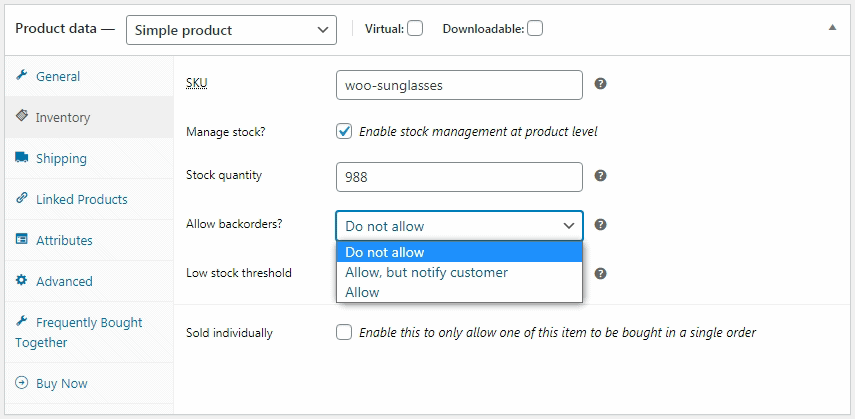
- Choose a Backorder option: Under Allow backorders, choose one of the following:
- Do not allow – Customers can’t buy the item when it’s out of stock (default setting).
- Allow, but notify customer – Customers can order the item and will be informed it’s on backorder.
- Allow – Customers can order the item, but they won’t be notified it’s out of stock.
- Save your changes: Click
Updateto apply the settings.
Managing backorders in practice: Store operations
Setting up backorders is only the first step. You also need a clear fulfillment strategy.
Handling mixed orders (Order #1042 example)
Suppose Order #1042 contains a $20 in-stock t-shirt and a $60 backordered jacket. You have two operational options:
- Split fulfillment: Ship the $20 t-shirt via FedEx today. Ship the jacket when restocked. This keeps buyers happy but adds a $7 shipping fee.
- Hold entire order: Set Order #1042 status to
On hold. Wait until the jacket arrives. Ship both items together in one box.
Admin visibility
In WooCommerce → Orders, backordered line items display a red Backorder tag. Your team can spot pending orders at a glance.
Scaling inventory control: Bulk managing backorders
Configuring backorders manually works for a few products. But for large catalogs, manual editing creates serious bottlenecks.
The problem with default WooCommerce
WooCommerce native allows to bulk edit backorders for simple products. It has no native bulk filter for backorder modes across specific categories or variations.
Editing backorders across 50 or 200 products variations means opening every edit screen one by one. This consumes a lot of time and energy.
Managing backorders at scale with Smart Manager
When managing 500+ SKUs, store owners use spreadsheet tools like Smart Manager. Smart Manager displays your store catalog—products, variations, orders, and coupons—in a single, high-speed grid.
Inline editing
Edit backorder settings directly from the grid:
- Click the Backorder column for any item.
- Pick Allow, but notify customer from the dropdown.
- Click Save. The change applies instantly without page reloads.
Bulk updates across categories and variations
Need to enable backorders for all XL T-Shirts with 0 stock?
- Use Advanced Search to filter items (
Stock Quantity <= 0ANDAttribute = XL). - Select all filtered results.
- Open Bulk Edit, choose
BackordersSet toAllow, but notify customer. - Click Update. Hundreds of variations can be update in under 30 seconds.
Backorder discounts
To ease shipping delays, offer a quick incentive:
- Filter all backordered items in Smart Manager.
- Use Bulk Edit to reduce sale price by 10% while items are backordered.
- This rewards patient buyers and maintains steady cash flow.
Exporting supplier reports
Need an exact list of items on backorder for your warehouse?
- Filter the grid by
Backorders = Allow. - Select columns for Product Name, SKU, Stock Quantity, and Supplier ID.
- Click Export CSV to send the report directly to your fulfillment team.
Where this leaves you
Backorders are a simple way to keep selling through a stockout as long as restock timelines are predictable and customers are kept informed.
Native WooCommerce covers the basics: three backorder modes, negative-stock tracking, and per-variation control.
Where it falls short is scale. Editing backorders one product at a time works fine for a handful of items, but becomes a bottleneck once you’re managing hundreds of SKUs or need to react quickly during a stockout.
That’s the gap tools like Smart Manager are built to close — bulk edits, filters, and exports on top of WooCommerce’s native settings.
Frequently asked questions
What happens when a customer orders a backordered item?
The payment processes normally upfront. The order is stored in WooCommerce with a backorder tag, awaiting fulfillment.
What is the difference between backorders and pre-orders?
Backorders apply to existing products temporarily out of stock. Pre-orders apply to unreleased products with future launch dates.
Can I enable backorders for specific variations only?
Yes. WooCommerce lets you toggle stock management and backorders independently for each variation.
How do negative stock numbers work?
If stock is 0 and 3 backorders occur, WooCommerce sets stock to -3.
When 10 new units arrive, adding 10 to -3 sets live stock to 7.