


Configuring a WooCommerce auto apply coupon eliminates one of the most persistent conversion leaks in eCommerce: coupon hunting abandonment.
When shoppers spot an empty coupon input box on a checkout page, many pause their purchase. They open a new tab to search discount aggregators. Studies show that uncontrolled coupon hunting can erode store profit margins by 8% to 15%, as shoppers either locate unapproved affiliate codes or abandon their cart entirely.
High coupon redemption numbers look impressive on top-line reports, but they often mask this exact margin erosion. Automatically applying discounts solves the problem. It rewards qualifying shoppers immediately, without asking them to hunt for or copy-paste voucher strings.
This guide walks through how to configure automated coupon triggers in WooCommerce without editing template files or maintaining custom PHP snippets.
Why configure a WooCommerce auto apply coupon?
A WooCommerce auto apply coupon automatically deducts discounts from qualifying orders without requiring manual code entry. By injecting valid savings at the exact moment purchase criteria are satisfied, you reduce checkout drop-off. You also prevent browser-tab switching and keep promotional codes safe from public scraper sites.
When managing standard WooCommerce coupons, store managers typically rely on customer memory or site-wide header banners. That manual workflow introduces three distinct operational points of friction:
-
Typing and formatting errors: Customers frequently mistype alphanumeric codes on mobile devices. They also paste trailing whitespace, triggering frustrating “coupon does not exist” notices.
-
Checkout hesitation: An exposed coupon entry box prompts shoppers to pause checkout and open Google in search of coupon codes.
-
Margin erosion from public scrapers: Publicly advertised coupon codes quickly get indexed by discount aggregators and browser extensions. This grants discounts to visitors who were already prepared to pay full price.
Automating the discount lets you target promotions with precision. You can reward high-value orders, returning VIP clients, or email campaign clicks while keeping standard checkout flows clean.
Free plugin: Auto Apply Coupons for WooCommerce
If you only need a single coupon to apply automatically without complex conditional rules, start with the free Auto Apply Coupons for WooCommerce add-on (version 1.3 on WordPress.org).
This lightweight plugin automatically applies 1 designated discount code at cart and checkout:
-
Select any standard WooCommerce coupon for automatic application (one coupon active at a time).
-
Auto-apply percentage discounts, fixed cart discounts, and product discounts.
-
Full support for WooCommerce Subscriptions sign-up fees and recurring discounts.
-
Restrict discounts to specific products or product categories.
When to upgrade to Smart Coupons
The free add-on handles basic single-coupon promotions. However, stores managing advanced marketing campaigns require deeper conditional logic:
-
Running multiple auto-applied coupons simultaneously (up to 5 codes).
-
Restricting automatic discounts by customer email lists, user roles, payment gateways, or shipping methods.
-
Generating one-click shareable URL coupon links with session persistence.
-
Setting automated BOGO deals and free gift additions.
Why custom PHP snippets fail on modern WooCommerce checkouts
You will find dozens of tutorials online offering custom PHP snippets that hook into woocommerce_before_cart or woocommerce_before_calculate_totals. While these snippets functioned reliably on classic shortcode-based checkouts, they are an operational liability on modern stores.
Starting in WooCommerce 8.0, WooCommerce ships by default with block-based Cart and Checkout interfaces. These Gutenberg blocks use client-side React components. They communicate with WordPress through the WooCommerce Store API, rather than traditional server-rendered template hooks.
Standard PHP action hooks do not fire during block-based cart updates. When merchants paste legacy snippets into functions.php, the coupon often fails to apply dynamically when line items change. In severe cases, it triggers infinite calculation loops during checkout validation.
Custom code also lacks safety guards for edge cases:
-
It cannot gracefully resolve conflicts when multiple automatic rules qualify.
-
It fails to handle guest session persistence if a shopper navigates between pages before adding items.
-
It bypasses usage limits when orders complete simultaneously.
A dedicated extension like Smart Coupons handles these conditions natively across both classic shortcodes and block-based checkouts.
4 ways to automatically apply coupons in WooCommerce
Depending on your promotional strategy, automated discounts should fire under different shopper conditions. Here are the 4 implementation methods available in Smart Coupons.
Trigger discounts based on cart subtotal conditions
The most common setup applies a percentage or fixed discount as soon as the cart reaches a specific spending milestone or contains qualifying items.
This strategy directly lifts your average order value (AOV). For example, rather than advertising a blanket 10% discount across your store, you can configure an automated rule: spend $75 or more to receive $10 off automatically.
When a shopper with $65 in their basket views their cart, you can nudge them to add an additional small item. As soon as the subtotal crosses the $75 threshold, Smart Coupons recalculates the order. It injects the discount immediately.
Apply discounts automatically via shareable URL links
For email newsletters, SMS marketing, social media ads, and influencer collaborations, forcing customers to copy a code causes steep conversion drop-offs.
With WooCommerce URL coupons, you generate a direct link that automatically applies the discount code when visited:
https://yourstore.com/?coupon-code=vip20You can direct the URL to a specific landing page, product category, or straight to the checkout page using query parameters:
https://yourstore.com/checkout/?coupon-code=flash15&sc-page=checkoutSmart Coupons stores the promotional code directly in the customer’s browser session. Even if the customer clicks the link before adding items to their basket, the discount remains active in their session. It applies automatically as soon as an eligible item enters the cart.
This mechanism also works cleanly for partner and affiliate links. Referred shoppers receive their promised discount without manual intervention.
Bind automatic discounts to customer accounts and emails
A frequent source of frustration for WooCommerce store owners is delivering private discounts to specific customers without making the coupon code public.
Store owners often attempt to create private discounts by changing the coupon’s WordPress post status to “Private”. However, WordPress restricts private post types to administrators and store managers. This causes regular shoppers to receive an immediate “coupon does not exist” error.
The proper architecture uses email-restricted auto-application:
-
Create your coupon and check the
Auto apply?setting. -
In the Allowed emails field under Usage restrictions, enter the customer’s email address or a comma-separated list of VIP clients.
-
When that customer logs into their account and adds items to their basket, Smart Coupons verifies their identity. It applies their exclusive discount automatically.
For guest visitors who subscribe via a newsletter popup, you can generate a single-use coupon bound to their email. When they proceed to checkout and enter their billing email address, the validation engine detects the match and applies the promotion on the fly.
Add free promotional gifts and BOGO items automatically
Discounts do not have to be limited to price deductions. You can use automated rules to add free promotional items directly into the basket when specific criteria are met.
Using WooCommerce BOGO offers, you can configure promotions such as “Buy 2 t-shirts, get a matching cap free”.
Instead of requiring the customer to locate the gift item and add it manually, the rule engine detects the qualifying items. It automatically adds the free item to the cart with a 100% discount applied.
Steps to configure auto-apply coupons with Smart Coupons
Setting up an automated coupon in Smart Coupons takes less than two minutes.
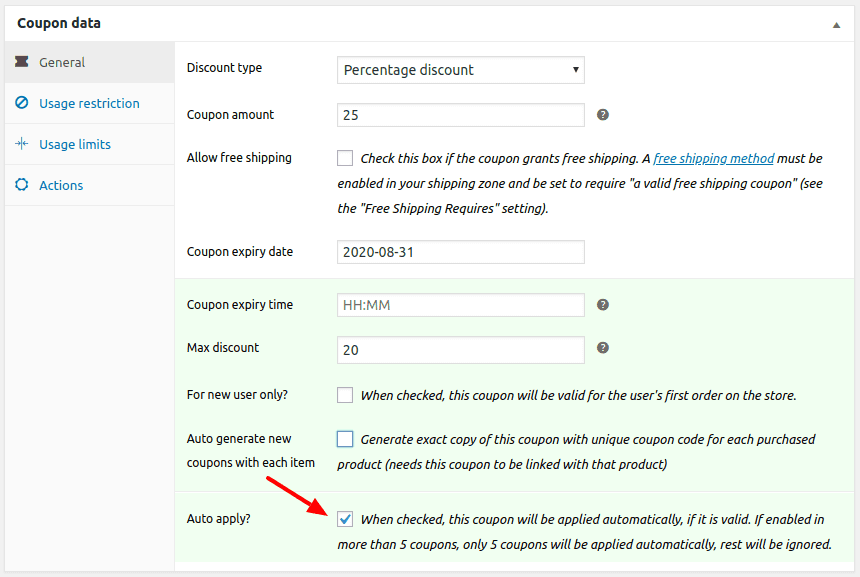
Follow these steps to configure your first automated coupon:
-
Go to your WordPress admin dashboard and navigate to Marketing → Coupons → Add coupon.
-
Enter a descriptive coupon code (e.g.,
SAVE10AUTO) or generate an algorithmically random code. -
Under the General tab, select your desired Discount type (Percentage discount, Fixed cart discount, or Fixed product discount) and enter the numeric Coupon amount.
-
Check the Auto apply? box. This flag tells the cart calculation engine to evaluate this coupon automatically on every cart update.
-
Configure usage restrictions under the Usage restriction and Usage limits tabs to establish necessary safety guardrails.
-
Click Publish.
Once published, open an incognito browser window. Add qualifying products to your cart, and verify that the discount applies to the cart subtotal without manual code entry.
How to set usage restrictions to protect your margins
An auto-applied coupon without usage restrictions will discount every single transaction on your store. To safeguard profitability, you must pair automatic application with appropriate constraints.
Review our dedicated guide on how to prevent coupon abuse for comprehensive bot protection. When configuring auto-apply rules, review these key settings:
-
Minimum spend requirements: Set a realistic minimum cart subtotal (e.g., $50) so small, low-margin orders do not qualify for fixed discounts.
-
Exclude sale items: Check Exclude sale items to prevent automatic discounts from stacking on top of already marked-down clearance inventory.
-
Specific product and category rules: Scope the promotion so it applies only to high-margin product lines rather than storewide.
-
User role restrictions: Restrict automated discounts to specific customer tiers (e.g., Wholesale, Subscribers, or VIP members) while excluding staff accounts.
-
Exact expiry timestamps: Default WooCommerce coupons expire at 00:00:00 on the selected date. Smart Coupons allows you to define exact expiration times (such as 11:59 PM store time), ensuring flash sales shut off precisely when advertised.
-
Individual use only: Check Individual use only if this coupon should never combine with other promotional codes.
How WooCommerce handles multiple auto-applied coupons (stacking rules)
A common concern among store managers is rule collision: what happens if a customer meets the criteria for two or three automated discounts at the same time?
In real-world store audits, stacking multiple uncontrolled percentage discounts can unintentionally reduce gross order margins by 10% to 20%. To prevent compounding promotions from zeroing out profit margins, Smart Coupons enforces strict execution limits. For detailed combination strategies, see our guide on how to stack coupons in WooCommerce.
The 5-coupon auto-apply limit
Smart Coupons caps the number of simultaneously auto-applied coupons at 5. This ceiling is governed by the internal filter wc_sc_max_auto_apply_coupons_limit.
If a cart qualifies for 7 automatic coupons, only the first 5 eligible coupons in priority sequence will execute. Developers can adjust this threshold using WordPress filters if a store has specialized tiered discount structures:
add_filter( 'wc_sc_max_auto_apply_coupons_limit', function( $limit ) {
    return 3; // Cap auto-applied coupons at 3
} );
Conflict resolution with individual use coupons
If one of the qualifying auto-applied coupons has Individual use only enabled, WooCommerce’s native coupon exclusivity logic takes precedence. The individual use coupon will apply, and all other auto-applied coupons will be excluded from the session.
If a shopper manually enters a standalone coupon code, Smart Coupons evaluates the individual use flags. If the manual code prohibits stacking, the automated coupons detach. This ensures the customer receives only the promotion they explicitly selected.
Can shoppers remove an auto-applied coupon?
Yes. By default, auto-applied coupons display a standard [Remove] link next to their line item in the cart and checkout totals breakdown.
This transparency is important for user experience. If a customer possesses a specialized single-use code that offers higher savings, they can remove the auto-applied baseline discount and apply their preferred code instead.
Store owners who want auto-applied promotional codes to remain permanently locked to the cart session can toggle this behavior using the wc_sc_auto_apply_coupon_removable filter.
4 high-converting auto-apply coupon strategies
Here are 4 proven promotional campaigns you can deploy using automated coupons.
Welcome discounts for first-time buyers
Instead of emailing new account registrations a generic code that gets shared online, configure an auto-applied welcome discount.
Set the restriction to For new user only or restrict it to customers with zero completed orders. When a new customer completes registration and adds their first item, the welcome discount fires immediately at checkout.
Tiered subtotal milestones for higher order value
Encourage larger cart sizes by creating multi-tiered threshold coupons:
- Tier 1: $10 off orders over $75.
- Tier 2: $20 off orders over $120.
- Tier 3: $35 off orders over $180.
Set each coupon to Individual use only. As the customer adds items and crosses each spending tier, Smart Coupons replaces the lower discount with the higher reward. This motivates shoppers to add one more product before finishing checkout.
Geographic shipping fee offsets
Shipping fees remain the primary cause of checkout abandonment. You can create an automated coupon that triggers exclusively for customers in specific geographic regions.
Under Smart Coupons location restrictions, select your target country or state (e.g., United Kingdom or California). Apply a fixed discount that cancels out standard shipping costs. When visitors from those locations reach checkout, the shipping fee offset applies automatically.
Time-boxed flash sales and holiday campaigns
During high-traffic events like Black Friday and Cyber Monday, server performance is vital. Forcing thousands of shoppers to validate coupon codes simultaneously creates database load on wp_postmeta.
By setting up an auto-applied storewide coupon with an exact start date and 11:59 PM expiration cutoff, every visitor receives promotional pricing automatically. The checkout process remains rapid. This eliminates server timeouts caused by repeated failed coupon lookups.
Summary & next steps
Manual coupon codes introduce friction, invite checkout abandonment, and expose store margins to automated coupon scrapers. Auto-applying discounts based on cart totals, customer identity, and campaign URLs delivers a frictionless shopping experience that protects your margins.
Get started by auditing your active promotions. Identify blanket discount codes that can be converted into cart milestone rules or shareable URL links.
Frequently asked questions
Can you auto-apply coupons in WooCommerce without a plugin?
Out of the box, core WooCommerce provides no native toggle to trigger discounts without manual code entry. Running automated discounts requires either custom scripts hooked into cart calculation actions or an extension like Smart Coupons to handle conditional triggers reliably.
Do auto-applied coupons work with WooCommerce Cart and Checkout blocks?
Yes. While custom PHP snippets often fail on block checkouts due to React-based client-side rendering, Smart Coupons fully supports Gutenberg Cart and Checkout blocks through modern WooCommerce Store API integration.
Can customers remove an auto-applied coupon from their cart?
Yes. By default, auto-applied coupons display a standard remove link in the cart and checkout totals breakdown. Store owners can override this behavior using the wc_sc_auto_apply_coupon_removable filter if mandatory promotional items are required.
What happens if a customer clicks a URL coupon link before adding products?
Smart Coupons stores the coupon code in the customer’s browser session. As soon as the visitor adds an eligible item to their cart, the coupon validates and applies the discount automatically without requiring the link to be clicked again.